
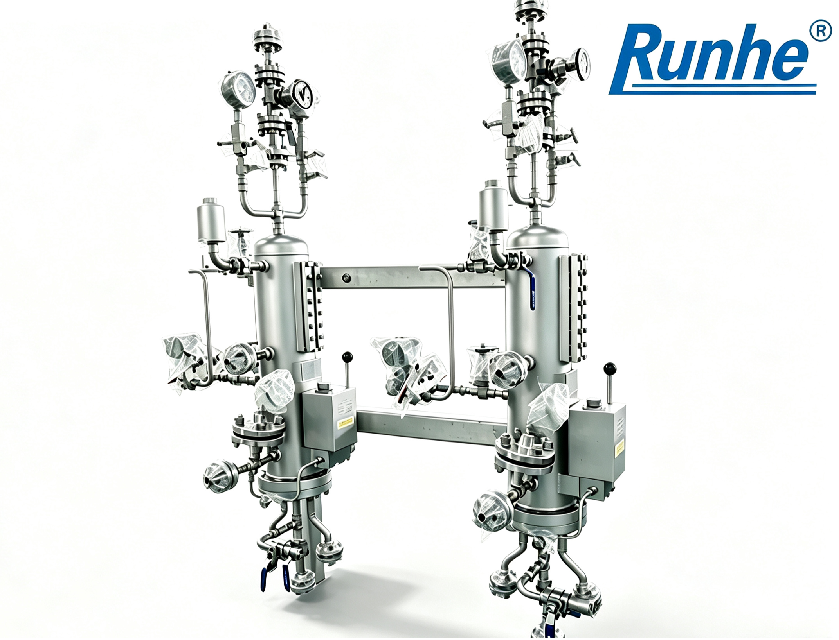
What is the Difference Between Plan 52 and Plan 53A Mechanical Seal Support Systems?
Many customers easily confuse Plan 52 and Plan 53A because their reservoirs look nearly identical. However, they operate on totally different working logic and protection effects.
Both are common seal protection solutions for chemical pumps and fully compliant with the API-682 industry standard.
Plan 52 (Atmospheric Buffer Fluid System)
Plan 52 is configured with tandem double seals. The reservoir works under atmospheric pressure and can be connected to a vent or flare system. The circulating medium inside the tank is defined as buffer fluid.
Simply explained, the inner primary seal directly contacts the process medium inside the pump and bears all working pressure, while the outer seal acts as a backup sealing component.
Buffer fluid only circulates to cool and lubricate the outer backup seal. The heat dissipation and lubrication of the inner primary seal completely depend on the original process fluid of the pump.
If the inner primary seal is damaged, process medium will leak into the buffer reservoir. Changes in liquid level and pressure inside the tank will trigger a leakage alarm,
and the leaked medium can be safely discharged through the flare system.
Advantages: No nitrogen gas supply is required. The buffer fluid will not mix with the process medium and will not cause product contamination.
Limitations: This system only realizes leakage monitoring and cannot prevent process medium from flowing into the auxiliary system.
The working condition of the primary seal relies on the stable liquid film formed by the process medium.
Application: Suitable for flammable and slightly toxic media. It applies to working conditions with an on-site flare recovery system and strict requirements against external fluid contamination.
Plan 53A (Nitrogen Pressurized Barrier Fluid System)
Plan 53A is matched with double end mechanical seals. The reservoir is pressurized with nitrogen, and the pressure of the internal barrier fluid is kept at least 1.5 bar higher than the pressure of the pump chamber
process medium. The internal circulating fluid is defined as barrier fluid.
In principle, nitrogen pressurization establishes a stable pressure barrier. The barrier fluid circulates continuously between the inner and outer seal faces.
Both sets of inner and outer seal faces are fully lubricated and cooled by barrier fluid, effectively isolating the seal faces from high-temperature and easily vaporized process media.
Due to the higher pressure of the barrier fluid, only a tiny amount of barrier fluid penetrates into the pump cavity under normal operation. The process medium is blocked by the pressure barrier and cannot leak
into the external environment. A drop in system pressure triggers an early warning, indicating barrier fluid loss or seal leakage.
Advantages: It achieves near-zero emission of process medium and improves field operation safety. Both seal faces obtain sufficient cooling and lubrication, making the system applicable for high-temperature,
easily vaporized and hazardous media.
Limitations: A stable and continuous nitrogen supply is necessary. A small amount of barrier fluid may mix into the process medium, so the barrier fluid must be chemically compatible with the product. Nitrogen
will dissolve in the barrier fluid under high pressure. The system can be upgraded to the Plan 53B bladder type system for higher standard working conditions.
Application: Ideal for highly toxic, highly volatile and dangerous process media that require strict near-zero emission safety standards.
#API‑682sealflushplan#mechanicalsealreservoirsystem#doublesealcirculationsystem# tandemvsdoublemechanicalseal# industrialpumpsealingsolution#zeroemissionpumpsealing


 export@rhseal.com


